

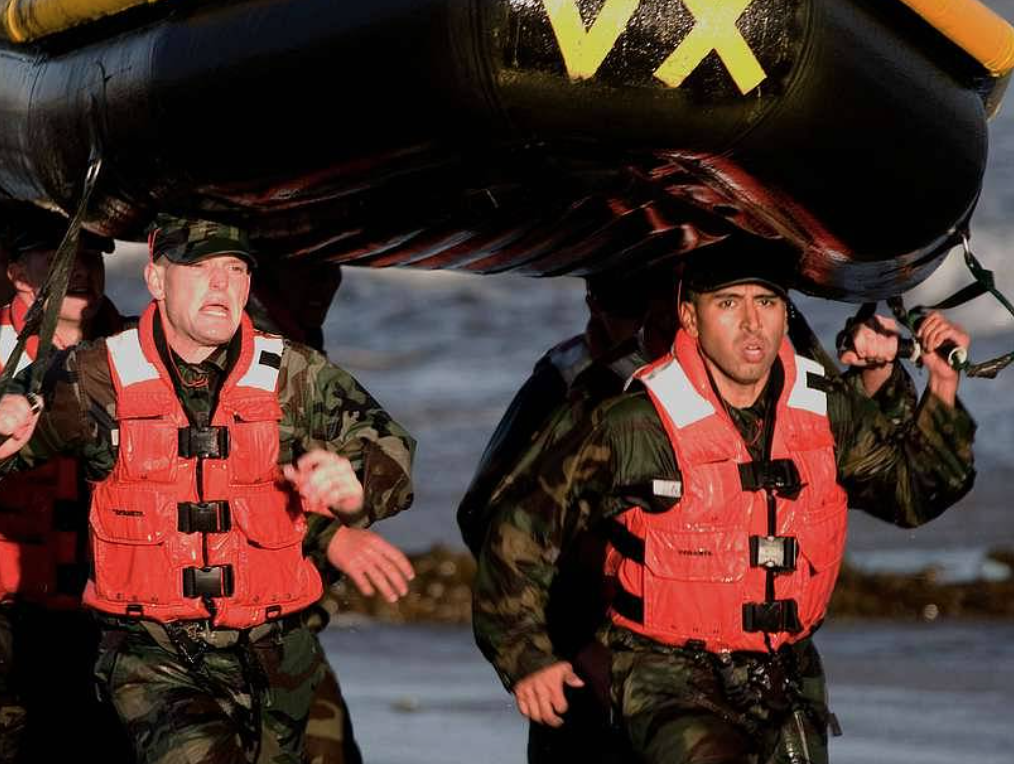
You may be wondering why I’d even ask this question!
Navy SEALs interest me because they learn Box Breathing as part of their training. And I teach Box Breathing as part of my training for veterinary teams. So I was curious to learn more.
In this article, I’ll share the similarities I found between SEALs and the veterinary staff members I’ve trained, in particular how they both benefit from Box Breathing. I’ll also include some new ways to benefit from Box Breathing for veterinary folks, inspired by the SEALs.
Things veterinary clinic staff and Navy SEALs have in common
Throughout the research I did on Navy SEALs, these things stood out as being the most similar between them and veterinary professionals:
- Have stressful work lives
- Depend on strong teamwork to succeed
- Want to make a difference with their work
It was also pointed out to me by a veterinarian friend that just like SEALs, many people in the vet world must be physically prepared for their role. If you work at an animal hospital, you may well know the muscle and coordination it takes to get a 135-pound Great Dane onto a surgical table, or to restrain an angry Rottweiler!
Another major commonality between veterinary professionals and Navy SEALs is that they both work in extreme circumstances.
SEALs thrive on extremes of danger, high risk and incredible challenge. And friends at vet clinics describe their own sorts of “extremes,” with typical workdays being an emotional rollercoaster.
For veterinary staff, dealing with clients in heightened emotional states of fear and worry is a constant. Ditto for swinging between joyful and sad events. Like going from welcoming a client’s new pet to sharing a sad prognosis with a worried pet owner. Or from performing a successful surgery to being there medically (and emotionally) for a euthanasia.
Why veterinary staff benefit from Box Breathing
Veterinary team members constantly need to maintain their emotional equilibrium, and not get triggered into defensive behavior by the (sometimes emotionally intense) behavior of stressed clients or coworkers.
If your veterinary team has done a Practice Smarts workshop, you’ve experienced how powerful Box Breathing is to short-circuit our defensive behavior. In fact, Box Breathing is one of the best tools we have to help:
- Remedy physiological signs of defensiveness: Racing heart, shallow breathing, sweaty palms, light-headedness, sudden headaches and stomach aches, and more.
- Stop negative thoughts or thought patterns: Thinking worst-case scenario, unfairly blaming others, unfairly blaming yourself, obsessively worrying, and so on.
- Prevent you from acting in a way that you’ll regret: Storming out, spacing out, breaking things, acting happy when you’re angry, and other uncomfortable behavior.
In general, Box Breathing is known as an easy way to invite focus and calm, in just about any situation—no matter how complex, and no matter how emotionally loaded or threatening.
Before I go further, I want to first take a moment to orient you to the world of Navy SEALs, by sharing a bit of the welcome message from their careers page:
Welcome to the clandestine world of Special Warfare, where only the toughest and most adaptable earn the coveted Navy SEAL warfare device. If you take the challenge, we’ll test your mental and physical limits. You’ll know what team work really means as we demand everything you’ve got — and more.

Now, that is definitely a different world than veterinary medicine.
With Navy SEALs’ high exposure to extreme danger, threats and challenges, mastering Box Breathing is very important to:
- Quickly regulate the nervous system
- Maintain situational awareness
- Execute tasks with greater accuracy
You’re not likely to hear veterinary folks trying to sound cool, saying they do Sniper Breathing, though that is a totally legit way to refer to Box Breathing. But the benefits (above) that Navy SEALs get from Box Breathing are also relevant to work in an animal hospital. For example, Box Breathing can be used to:
- Quickly regulate the nervous system – Like after you were just bit by a large, skittish patient, or you get a complaint from the Veterinary Medical Board during a busy day.
- Maintain situational awareness – Keeping an eye on the cat who hasn’t yet scratched anyone, or spotting the scalpel blades the new vet tech carelessly left in the sink.
- Execute tasks with greater accuracy – Like an anal gland expression for an upset Jack Russell Terrier, or preparing for a complex surgery after an argument.
No matter if you work in veterinary care or specialized warfare, all of us humans are wired with the same sort of physiology, which explains why Box Breathing works so well for just about anybody. If you’re curious about the biological reasons Box Breathing is so effective, be sure to check out the “science-y look at why Box Breathing works” section in this article.